
Most people use Large Language Models (LLMs) to write emails or summarize meetings. I used one to buy dishwasher powder and a car.
It started with a rabbit hole. I watched a Technology Connections video where Alec the host argued that if you want peak performance from your dishwasher, you should ditch the tablets for old-school powder.
Naturally, I went to Amazon first. All I found was an overpriced US import. Local grocery sites like Tesco weren’t much better as they didn’t seem to stock any. I didn’t want to spend my Saturday afternoon manually scouring the web for “boring” product data.
I wanted a shortcut. So, I outsourced the legwork to an LLM.
The “Deep Research” Method
I gave the model a simple task: Find dishwasher powder in the UK and return a table with the following columns:
- Product Name
- Shop
- Direct URL
- Total Cost
- Cost per Kilogram
- Review info
My favourite column is the one about cost per kilogram. Mainly because that to me is the true cost of the item, and that is basic maths the LLM can just about do. Finally i want it to give a recommendation of what it thinks would fit my requirements.
The Amazon Blind Spot
During this process, I hit a technical wall that every consumer should know about: Amazon blocks bots and others probably do too.
Because Amazon prevents AI models from scraping their site, the LLM will never see their current stock or pricing. This creates a massive data gap. Which basically means that your pool of information isn’t going to be perfect, so again you have to kind of use your own judgement here. However, this “blind spot” was totally fine for me as it got me too good enough. In the end, to my surprise, the model flagged Waitrose as the top contender. I walked to my local branch, and there it was, exactly what I needed, at the right price.
What I find really interesting is that I never would have thought to buy this from Waitrose in the first place. They actually got a sale out of me, simply because the AI pointed me to a shop I’d normally completely overlook for this kind of thing.
A Window into the Future (with a Warning)
This isn’t a “set it and forget it” tool yet. In the first pass, the model hallucinated a few URLs. It wasn’t a failure of the prompt, but a reminder that these models aren’t perfect. You still need a human in the loop to double-check the final links before hitting “buy”.
But as a window into the future of shopping? It’s transformative. It isn’t just about saving a few pounds on soap; it’s about reclaiming time and eliminating decision fatigue.
Scaling to the Big Stuff
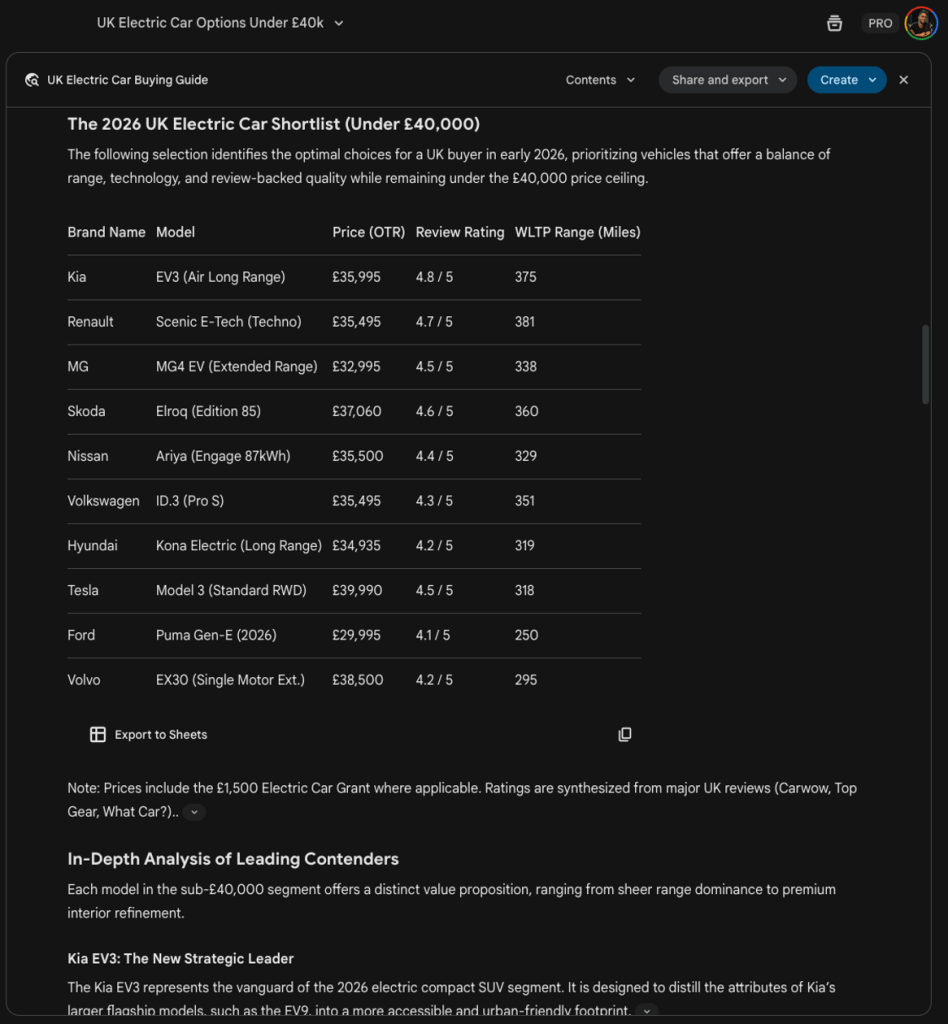
To prove this wasn’t a fluke, I used the exact same logic to buy my last car. I fed the model my requirements:
- Range
- Price bracket
- Specific features
The AI whittled a massive market down to a top 10 list. We went back and forth until I had a shortlist of three. I test-drove two and bought one. It turned a weeks-long research project into a streamlined, logical process.
If you’re still doing your own manual research for products, you might be working too hard.
 Fizzy Logic: My Messy AI Journey
Leave a comment