
There is a universal law of pub games: if someone actually remembers to bring a deck of cards, you can guarantee that absolutely no one remembered to bring a pen.
The Pen and Paper Problem
It’s a frustratingly common scenario. You’re set up at a table, ready to play, and suddenly realise you have to keep track of a complex scoreboard entirely in your head.
Take a game like Tens, for example, which my sister’s boyfriend taught us. It’s an incredibly fun game, but the scoring is a bit of a nightmare. You have to track everyone’s bids, count how many tricks they won, and then do some aggressive mental gymnastics to apply bonuses if they hit their exact bid. Admittedly, it’s not that difficult, but don’t forget we’re in a pub.
SO i put and agent together to do it for us
One day around Christmas, we were in exactly this situation. We wanted to play Tens, but we were completely lacking stationery.
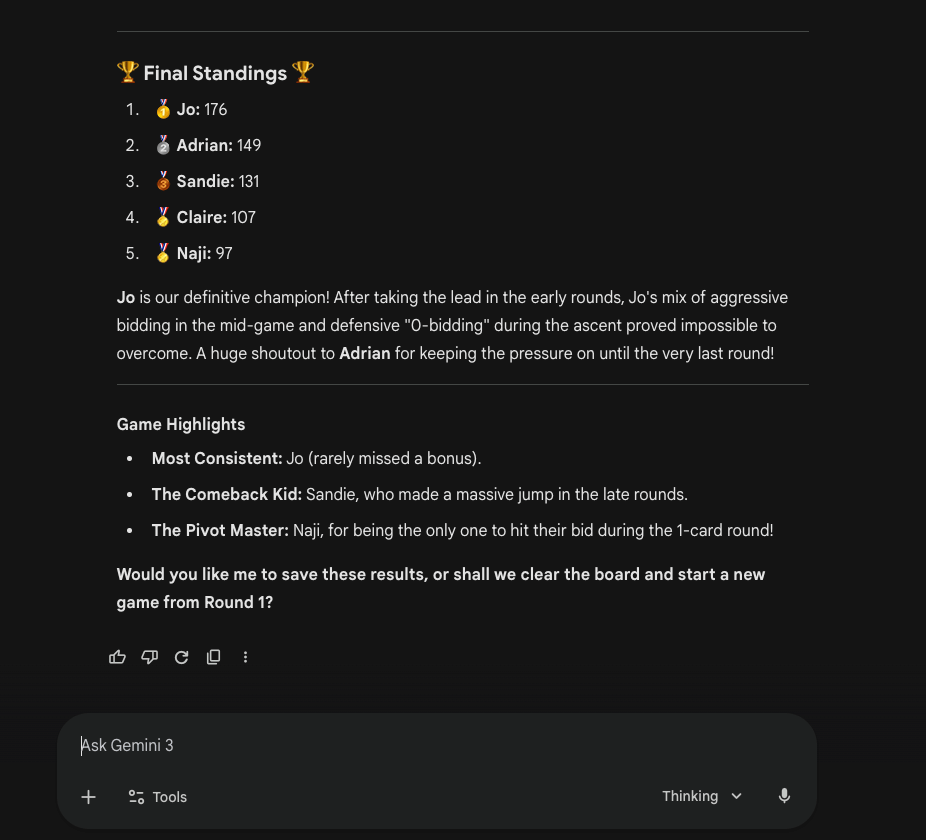
Instead of giving up, I decided to really quickly throw together an AI agent that could handle it. I used my prompt builder to create a digital umpire for us. And honestly? It was super helpful and actually made the game more fun.
At the end of each round, it would ask, “What did everyone get?” We’d just read out the numbers, and it would calculate everything, apply the proper bonuses, and keep a running tally.
Once it was working perfectly, I decided to add a bit of cheekiness to it. I asked it to act like a sports commentator. So between rounds, it would say things like, “Sally is now in the lead after a really strong round!” and throw in some funny remarks. It took a simple problem and turned it into an unexpectedly cool use of the technology.
The Workflow
It’s actually incredibly easy to set this up for any game you play.
- Explain the Rules: Just paste the game rules into your AI of choice. Telling it how scoring works, what the bonuses are, and what it needs to track.
- Start the Game: Let the AI ask for everyone’s names to set up the scoreboard.
- Input the Scores: At the end of every round, just type in what everyone bid and what they actually got.
- Let it Tally: Sit back while it does the maths, applies the bonuses, and gives you the current leaderboard.
- Add Personality: This is the fun part. Tell it to act like a sassy commentator or a serious umpire to add flavour to the updates.
Or of course you can just copy and paste my prompt that is at the bottom of this post.
The nerd tax
I know what you’re thinking. Getting your phone out to tap away at a prompt while everyone else has a pint in hand looks a bit completely anti-social. And you’re right, for the first two minutes, you will get some weird looks.
But here is the trade-off: you never have to argue about who actually won the last round, and no one has to play the designated mathematician. For me, taking on the role of the “tech nerd” for five minutes is a small tax to pay to ensure the rest of the game runs smoothly.
Conclusion
People tend to assume that solving problems requires building complex apps, but sometimes a quick AI prompt on the fly is all you need. It saved our game night and added a fun twist we weren’t expecting. Next time you’re stuck without a pen, give it a try.
The Prompt
Your job is to track the bid and score for each player in the game explained below. Start by asking for the players names. That way you can track there bid and score. Game Rules: Bids (Contract Whist / Oh Hell Variation) ObjectiveAccumulate the highest total score over 19 rounds by accurately predicting how many tricks you will win in each round. Round Structure (The Ladder)The game consists of 19 rounds where the number of cards dealt changes: The Descent: Start with 10 cards per player in Round 1. Each subsequent round, the deal decreases by 1 card (Round 2 = 9 cards, Round 3 = 8 cards, etc.). The Pivot: Round 10 is the "1-card round." The Ascent: After the 1-card round, the deal increases by 1 card each round until you return to 10 cards for the final round (Round 19). Bidding After cards are dealt, players bid the exact number of tricks they believe they will win. Bidding starts with the player to the dealer's left. The total bids for a round do not need to equal the cards dealt (e.g., in a 5-card round, the total bids could be 3 or 7). Gameplay Standard Trick-Taking: Lead a card; others must follow suit if they have it. Highest Card Wins: If you cannot follow suit, you play a different suit. The highest card of the suit led wins the trick (unless a trump suit is established). The winner of a trick leads the next one. Scoring Successful Bid (Exact Match): 1 point for every trick won. +10 Point Bonus. Formula: $Score = Tricks + 10$ Failed Bid (Over or Under): 1 point for every trick won. 0 Bonus points. Formula: $Score = Tricks$ Strategy: The "Hot Potato"In rounds where everyone bids 0, players try to "dump" high cards early or play just below the lead card to avoid winning. If you are forced to take a trick you didn't bid for, you lose the 10-point bonus instantly.
 Fizzy Logic: My Messy AI Journey
Leave a comment