The Button That Told On Me
A few weeks ago I added a little “quick add” button to my kanban app. Yes, the kanban app I vibe coded myself, because of course I did. The button had exactly one job: log whatever task I’d just handed off to Microsoft Cowork or WPP Open (or any other agent).
Why? Because I kept forgetting what I had running. I’d kick off a job, move on, and ten minutes later have no real idea what was cooking in the background. That little button says a lot about how my work has changed. Something about the way I do things has completely shifted.

Stack, Stack and Stack Again
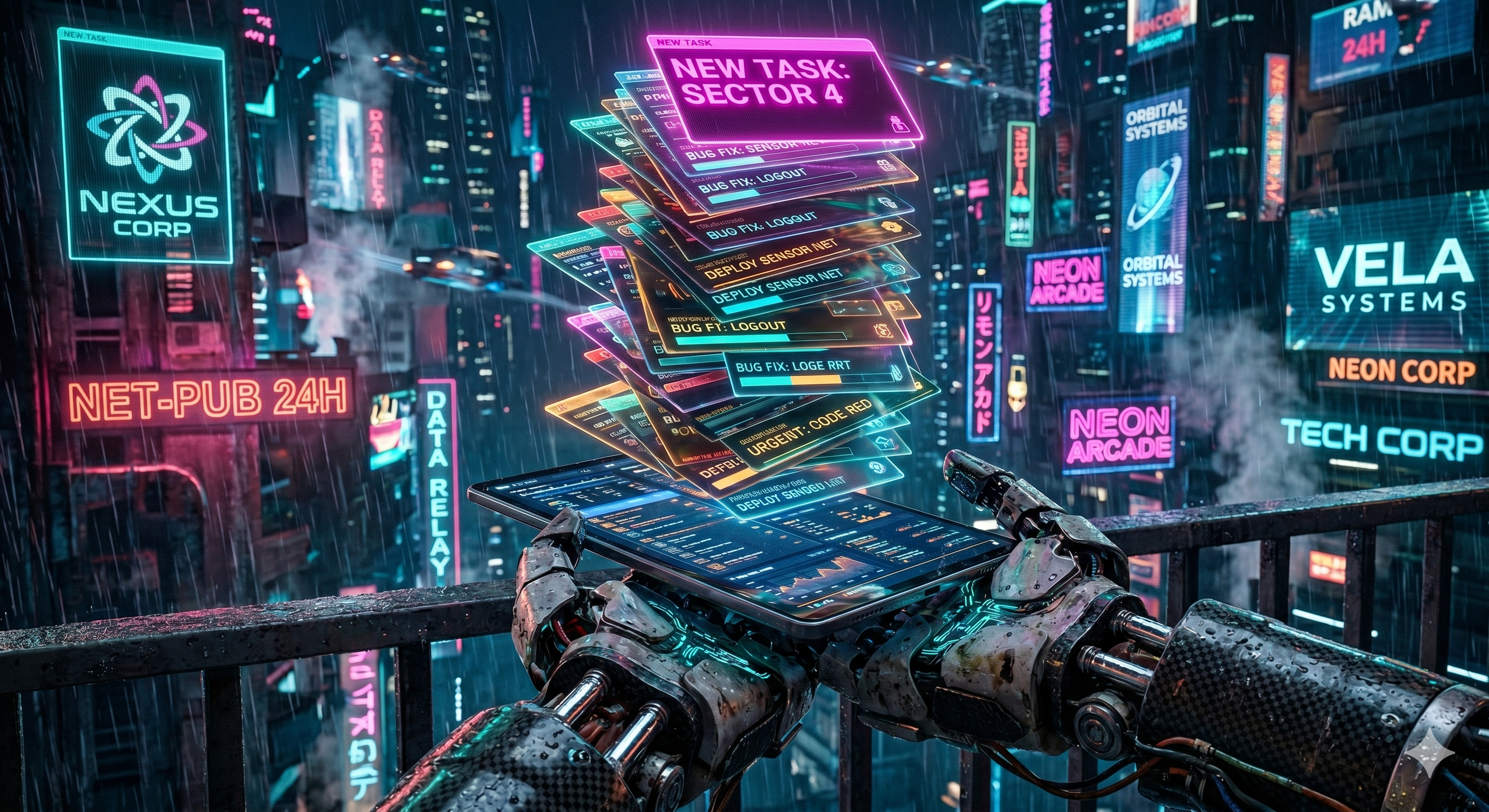
Here’s what changed. These systems now do work that takes real time. Not three seconds. More like thirty minutes a task. And when something takes thirty minutes, you don’t sit there and watch it. You prompt another one. Then another. Then another.
I wrote a while back about why you shouldn’t sit and watch the LLM work, and stacking jobs like this is the natural next step. But it turns out stacking them is only half the story.
So at any given moment I’ve got a stack of jobs running. Knowing what each one is doing is the easy part, that’s literally what the button is for. The hard part, the actual skill, is jumping between them.
And it gets trickier. Cowork doesn’t just go quiet for half an hour and hand you a finished thing. It works for a bit, then comes back with clarifying questions. So you’re not just checking on progress. You’re getting yanked out of one piece of work to make decisions about a completely different one.
The Day I Became a Machine
Let me give you a real example. At one point last week I was switching between three totally different worlds, back to back to back.
First, I was deep in the data for our next Future Shopper report. The fresh dataset had just landed and I needed to go through it, find the interesting stats, and build a highlights doc. The overall spreadsheet alone has fifty tabs. Fifty and some have 1000+ rows of data!! A humongous amount of data to wade through.
Then I got pulled across to a piece of client work on personas, looking at how we could surface certain information through an LLM. I’ll keep that one vague, but it meant looping over a load of documentation to dig out specific bits of data.
Then, on top of all that, I was prepping a Copilot training session I was about to deliver, which itself included a section on Microsoft Cowork.
Report data. Client personas. Training prep. Three completely different mental contexts, and I was bouncing between all of them as the agents kept pinging me for answers.
And here’s the kicker: those were just the agent tasks. I still had another five or so “normal” things to get through that day. The usual stuff doesn’t politely wait just because the robots are busy.
It was almost the most productive week of my life. It was also, hands down, the most mentally drained I have been in a while (at one point I just did some vacuuming to chill out for a min). I felt like a machine. Honestly it was like playing a video game and chasing the high score, trying to squeeze value out of every single minute of every single day.
And here’s the thing about chasing the high score: you can’t do it forever.
Slow Down on Purpose
So I’ve had to get deliberate about this. Really deliberate.
The big one: don’t run at full tilt just because you can. If these tools suddenly make you 200% more efficient, don’t run at 200%. Aim for 150% and bank the rest. There’s no prize for breaking yourself.
Part of how I do that now is saving about 20% of my effort for reading and double-checking the work. That does two things at once. It forces me to slow down so I’m not completely fried, and it keeps the quality up, because all that output still needs a human who actually understands it.
We have to stop feeling guilty about not sprinting all the time. Work is a marathon, not a sprint. We’re playing for long-term success, not a one-week high score.
One Thing That Actually Helps
If you take one practical tip from all this, make it this one: when you give Cowork a long task, get it to plan first before it changes anything.
Leave it five minutes to put a plan together, check the plan, then let it run. It sounds small, but it saves you from the worst context-switching trap there is. You know the one: you come back after thirty minutes expecting a finished job, and instead the agent stalled ten minutes in with two questions and has just been sitting there doing nothing while it waited for you. Plan first, fewer interruptions, fewer forced switches. Your brain will thank you.
We’re Just Animals
We’re all still figuring out how to work with this stuff. I know you see AI takes everywhere right now, but I think it matters to share the good and the bad, especially when things are moving this fast.
And let’s be honest with ourselves. We’re just animals. We can’t evolve anywhere near as fast as this tech is changing how we do things. So the responsibility is on us to be deliberate, to protect our own heads, and to not mistake “I can” for “I should.”
Pace yourself. It’s a marathon.
Leave a Reply